Tape-In vs. Hand-Tied vs. Fusion Hair Extensions: Which Is Best?
Expert Reviewer: Jordan Kalafat
The best hair extension method is not determined by which technique is most popular. It is determined by how well the method fits your natural hair, desired result, styling routine and maintenance expectations.
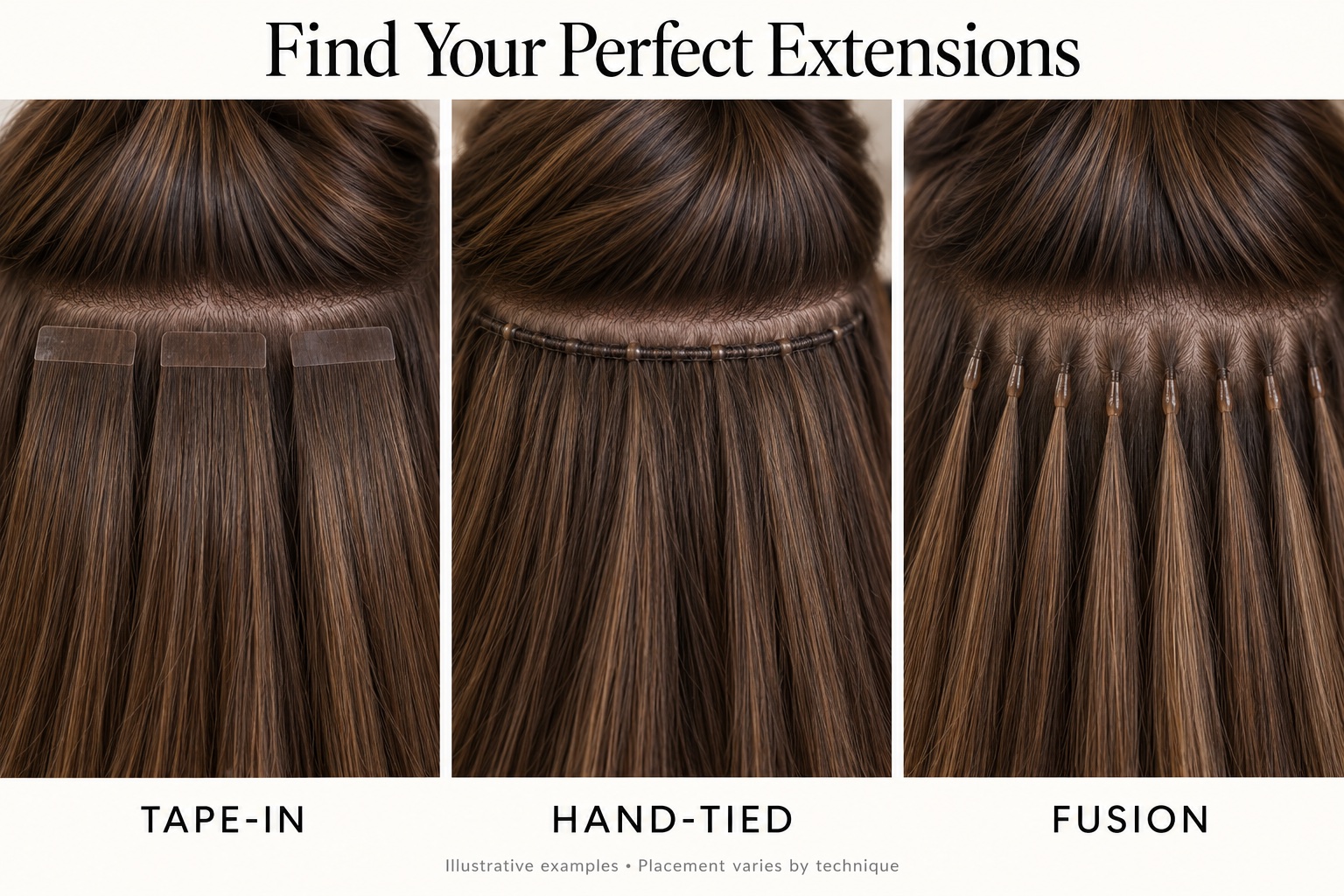
Tape-in, hand-tied weft and fusion extensions can all add length and volume. They create those results through different attachment designs and patterns of weight distribution.
At Salon @ 31st Day Spa in Virginia Beach, we offer tape-in extensions, Babe hand-tied wefts, fusion extensions and fashion-color options using Luxury Remy 100% human hair. de explains how the three primary methods differ and which questions should guide your decision.
The Quick Comparison
Feature | Tape-In | Hand-Tied Weft | Fusion |
Attachment design | Thin adhesive panels | Wefts attached along customized rows | Individual bonded strands |
Placement pattern | Distributed panels | Concentrated across one or more rows | Highly individualized placement |
Common objective | Efficient length and volume | Broad fullness and a denser perimeter | Detailed placement and natural movement |
Installation style | Panel by panel | Row by row | Strand by strand |
Movement | Natural when appropriately placed | Full movement between rows | High individual-strand movement |
Updo planning | Placement must account for part and hairline | Row position must account for ponytails and concealment | Individual placement can be customized around styling |
Maintenance approach | Removal and move-up or reinstallation | Row move-up or reinstallation | Professional removal and replacement as directed |
Main consideration | Adhesive care and concealment | Weight distribution across each row | Appointment time and precise removal |
The Most Important Principle
There is no extension method that is automatically best for every client.
An excellent method installed on the wrong candidate can produce a poor result. A thoughtfully selected method installed in the right amount can look natural and remain comfortable.
The decision should account for:
Natural density
Strand strength
Current length
Hairline condition
Desired length
Desired volume
Preferred hairstyles
Washing and styling routine
Maintenance availability
Budget
Tape-In Hair Extensions
Tape-in extensions consist of thin panels of extension hair with professional adhesive near the top. A section of natural hair is placed between or alongside the extension panels according to the specific system.
Babe Hair Extensions describes tape-in as a method designed to produce efficient length and volume through pre-taped wefts. clients consider tape-ins
Tape-ins may appeal to clients who want:
Added length
Increased volume
A relatively flat attachment
Efficient installation
Hair that can be removed and repositioned during maintenance
Density distributed across several areas
Where tape-ins can perform well
Tape-ins can be useful when the stylist needs to add volume through the sides and back while maintaining a relatively streamlined attachment.
The panels can create noticeable density efficiently because each attachment carries a section of extension hair rather than one individual strand.
Important tape-in considerations
Tape-in success depends heavily on:
Clean, properly prepared natural hair
Correct section size
Appropriate placement
Keeping incompatible oils and conditioners away from the adhesive
Thorough drying
Timely maintenance
Professional removal
Tape-ins placed too close to the part, hairline or fragile areas may be difficult to conceal or may create unnecessary stress.
Tape-ins and ponytails
Clients can often wear ponytails with tape-ins, but the stylist must know how the client wears the hair.
Tell your stylist whether you prefer:
Low ponytails
High ponytails
Half-up styles
Tight gym styles
Formal updos
The planned placement should reflect those habits.
Tape-ins may be worth considering when:
You want an efficient length-and-volume transformation
You prefer a relatively flat attachment
Your hair can conceal the panels
You can follow adhesive-specific product instructions
You can return for scheduled move-up appointments
Hand-Tied Weft Extensions
Hand-tied wefts consist of extension hair arranged into thin wefted sections. The wefts are attached along a professionally created foundation or row.
Salon @ 31st currently offers Babe hand-tied wefts. Babe describes its hand-tied weft method as a high-volume option designed to create substantial fullness. clients consider hand-tied wefts
Hand-tied wefts may appeal to clients seeking:
Significant overall fullness
A denser-looking perimeter
Longer hair with visual weight through the ends
One or more customized rows
Fuller waves, curls and blowouts
Where hand-tied wefts can perform well
Wefts add density across a broader horizontal area. This can make them effective for clients who want a fuller overall silhouette rather than only a few targeted pieces.
They can also create strong visual density through the ends, which is important when adding substantial length.
Important hand-tied considerations
The stylist must determine:
How many rows are appropriate
Where each row should be positioned
How much hair each row should carry
Whether the natural density can support the desired result
How the rows will remain concealed
Whether the client’s ponytail and updo preferences are compatible with the placement
More rows do not automatically mean a better result. Adding excessive weight can create discomfort or unnecessary stress.
Hand-tied wefts and fine hair
The phrase “hand-tied” does not automatically mean a method is right or wrong for fine hair.
Fine hair can vary significantly. One client may have fine individual strands but high density. Another may have both fine strands and low density.
A stylist must assess:
Strand strength
Overall density
Hairline condition
Breakage
Where the row would be supported
Whether enough hair is available for concealment
Hand-tied wefts may be worth considering when:
You want broad, noticeable fullness
You want a stronger perimeter through the ends
Your hair has enough density to conceal and support customized rows
You can commit to regular row maintenance
You frequently wear the hair down or in styles compatible with the planned row placement
Fusion Hair Extensions
Fusion extensions are installed strand by strand. Small sections of extension hair are attached to small sections of natural hair using a professional bonding system.
Babe describes fusion as a strand-by-strand method designed for customized placement and natural, multidirectional movement. clients consider fusion
Fusion may appeal to clients who want:
Precise placement
Natural individual-strand movement
Density distributed in small sections
Detailed customization
Extensions positioned around a particular haircut or styling goal
Where fusion can perform well
Because fusion pieces are installed individually, the stylist can vary placement more precisely than with broad panels or wefts.
This can be useful when:
Volume is needed in targeted areas
Natural movement is a high priority
The client wants flexibility in how the hair separates
The haircut requires carefully distributed density
Important fusion considerations
Fusion typically requires:
A longer installation appointment
Careful sectioning
Correct bond size
Professional home-care instructions
Professional removal
A realistic maintenance and replacement plan
Fusion bonds should not be cut, pulled or removed at home.
Fusion and styling flexibility
Individual placement can provide flexible movement, but the installation must still be planned around:
Hairline visibility
Parting
Ponytails
Updos
Heat styling
Natural density
Individual bonds do not eliminate the need for strategic concealment.
Fusion may be worth considering when:
You want highly customized placement
Natural individual movement is important
You are comfortable with a longer installation
You can commit to professional removal
Your natural hair is suitable for individual bonded attachments
Is One Method Less Damaging Than the Others?
There is no responsible universal answer.
Damage risk depends more on the complete service than on the method name alone.
Important factors include:
Whether the client was an appropriate candidate
How much weight was added
Whether the attachment was correctly sized
Whether the installation created tension
How the extensions were maintained
Whether removal was performed professionally
Whether the client followed home-care instructions
Whether the natural hair was given appropriate attention
A poorly fitted “gentle” method can cause problems. A correctly selected and carefully installed method may be worn successfully.
The American Academy of Dermatology advises having extensions installed professionally and speaking up if an installation causes pain or a headache. Persistent pulling can contribute to traction alopecia and potentially permanent hair loss.
Which Method Is Best for Volume?
All three methods can add volume, but they distribute it differently.
Tape-in volume
Tape-in panels can add density efficiently across several areas.
This may be helpful for:
Fuller sides
Added overall density
Moderate length and volume transformations
Hand-tied weft volume
Wefts create density across rows and can build a full-looking perimeter.
This may be helpful for:
Broad fullness
Longer, denser ends
More dramatic volume
Fusion volume
Fusion allows density to be placed in smaller, more individualized sections.
This may be helpful for:
Targeted areas
Detailed balancing
Customized movement
The best method depends on where the client needs volume and how much natural hair is available to support it.
Which Method Is Best for Length?
Length requires sufficient density through the ends.
When hair is extended significantly, the stylist must add enough extension hair to avoid a thin or stringy result. However, the natural hair must also be able to support that amount.
A dramatic length transformation may require:
More extension hair
More installation time
Additional color blending
A more substantial maintenance commitment
Careful shaping and blending
The client’s desired length should be evaluated in relation to natural density, not selected in isolation.
Which Method Is Best for Fine Hair?
Fine hair should be assessed in person.
The stylist needs to distinguish between:
Fine strands with high density
Fine strands with medium density
Fine strands with low density
Fragile or damaged fine hair
Active thinning or shedding
The ideal installation may involve:
Less total extension hair
Shorter added length
More strategic placement
Reduced weight near fragile areas
A volume-focused result rather than dramatic length
Fine hair does not always require the same method. It requires a more conservative and individualized plan.
Which Method Is Best for Active Clients?
Exercise itself does not rule out extensions, but frequent sweating, washing and ponytail wear should influence the plan.
Active clients should discuss:
How often they wash their hair
Whether they wear tight gym ponytails
Swimming habits
Hot yoga or sauna use
How quickly they can dry their roots
Whether work or exercise requires the hair to remain tied up
The right choice is the method you can care for consistently, not merely the one you like most in a photograph.
What About Fashion-Color Extensions?
Fashion-color extensions can add vivid or contrasting shades without lightening as much natural hair.
They may be used for:
Face-framing color
Peekaboo sections
Colorful braid accents
Seasonal changes
Special events
High-contrast dimension
Salon @ 31st offers fashion-color extension options along with natural shades. Attachment method should still be chosen according to the client’s hair and desired placement.
A Practical Decision Guide
Tape-ins may fit your goals when:
You want efficient length and volume
You prefer a flat panel-style attachment
Your hair can conceal the panels
You can follow adhesive-specific care
Hand-tied wefts may fit your goals when:
You want significant overall fullness
You want a denser perimeter
Your hair can support and conceal customized rows
You can maintain the row schedule
Fusion may fit your goals when:
You want detailed, individualized placement
Natural strand movement is a priority
You are comfortable with a longer installation
You will return for professional removal
These descriptions are starting points, not final recommendations.
Questions to Ask During Your Consultation
Ask your stylist:
Why are you recommending this method for my hair?
How much extension hair will I need?
Is my desired length realistic?
Where will the attachments be placed?
Will I be able to wear my usual ponytail?
How often will I need maintenance?
Can the extension hair be reused?
What should I avoid near the attachments?
What will professional removal involve?
What is the estimated initial and ongoing cost?
What should I do if an attachment hurts?
What result would be safest and most natural for my density?
A strong consultation should leave you understanding both the recommendation and the reasoning behind it.
Schedule a Hair Extension Consultation in Virginia Beach
The best way to choose between tape-in, hand-tied and fusion extensions is to have your natural hair evaluated in person.
During your consultation at Salon @ 31st Day Spa, a trained professional can evaluate your hair, discuss your desired result, compare available methods and prepare a personalized price quote.
Salon @ 31st Day Spa
213 Laskin Road
Virginia Beach, VA 23451
Steps away from the Neptune Park, at the Virginia Beach Oceanfront
Call 757-233-2631 to schedule a complimentary hair extension consultation during our assistance hours:
Mondays/Wednesdays - 9am to 6pm
Tuesdays, Thursdays to Saturdays - 9am to 7pm
Sundays - 11am to 5pm
If you prefer to book online for the consultation, click here.